Math Flashcards
Printable math flashcards for all four operations, with facts from 0 to 12. Each set prints the questions on one page and the answers on the next, mirrored so they line up when you print double-sided — or print single-sided and fold. The pack also includes flashcard games and a fact-mastery tracker.
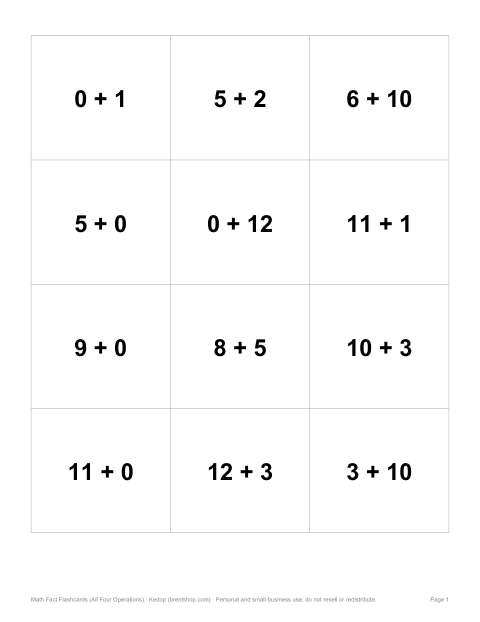
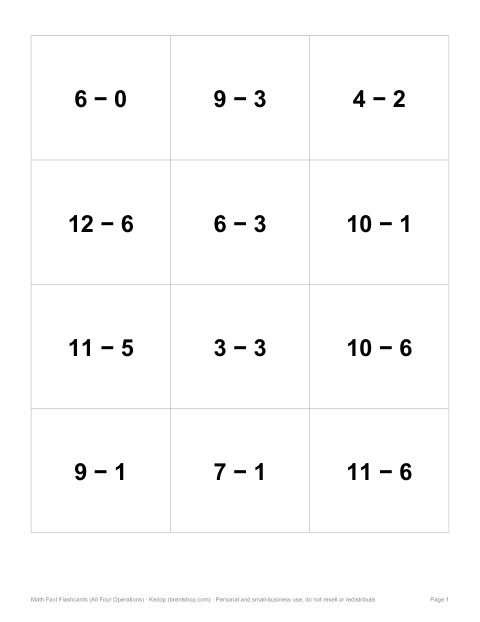
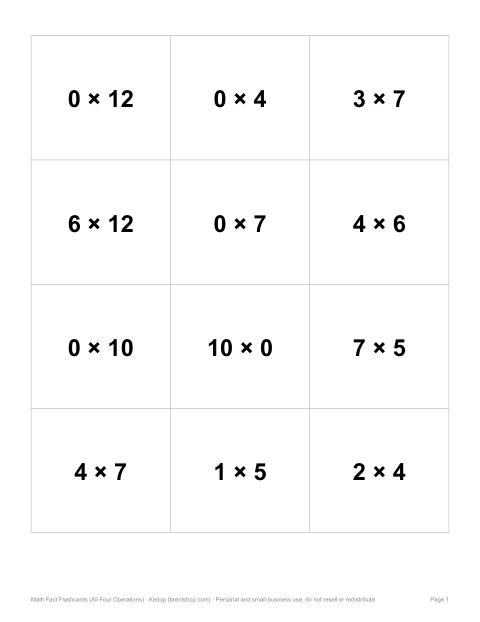
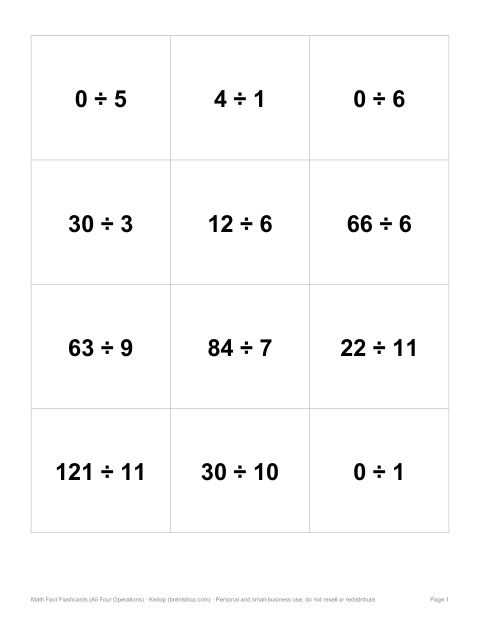

Math Fact Flashcards (All Four Operations)
Printable double-sided addition, subtraction, multiplication and division flashcards, blank cards, a game guide and a fact-mastery tracker.
- Addition flashcards (PDF)
- Subtraction flashcards (PDF)
- Multiplication flashcards (PDF)
- Division flashcards (PDF)
- Blank flashcards (PDF, DOCX)
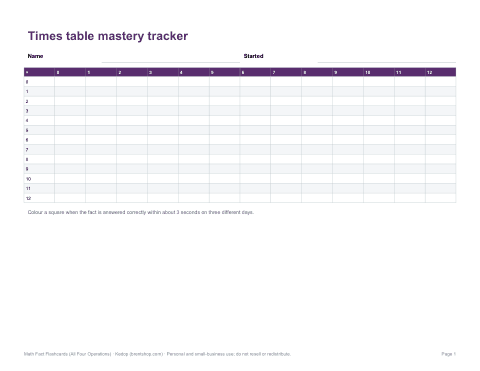
- Fact mastery tracker (PDF, XLSX)
Formats: PDF, DOCX, XLSX. Instant download after payment (link valid 72 hours, up to 5 downloads). AI-assisted: the templates were drafted with AI help and reviewed and laid out by Kedop.
$5.00 USD, one-time
Secure card checkout by Stripe. Full refund within 7 days — see the refund policy and license.
What is in the flashcard pack
| Set | Facts | Best for |
|---|---|---|
| Addition | Sums of two numbers from 0 to 12 | Kindergarten to grade 2 |
| Subtraction | Differences within 24, no negatives | Grades 1–2 |
| Multiplication | Times tables 0–12 | Grades 3–4 |
| Division | Division facts matching the times tables | Grades 3–5 |
| Blank cards | Write your own facts or vocabulary | Any subject |
| Fact tracker | Mark facts as learning, nearly there, or mastered | Tracking progress |
Each operation set contains 24 cards per sheet pair; print the sets you need and mix them for review.
How to print double-sided flashcards
- Print the first two pages of a set on card stock with duplex (two-sided) printing, flipping on the long edge.
- If your printer is single-sided, print page 1, put the sheet back in the tray the right way round, and print page 2 on the back — test on plain paper first.
- Check that the answer is behind the right question before cutting.
- Cut along the card borders with a paper trimmer.
- Store sets in labelled envelopes or on a binder ring punched through one corner.
The answer pages are mirrored row by row, so the card in the top-left on the front has its answer in the top-right on the back. When the sheet is flipped on the long edge, they line up.
Why flashcards help with math facts
Fluency with basic facts — being able to recall 7 × 8 or 13 − 5 quickly and accurately — frees working memory for multi-step problems, fractions and algebra later. Flashcards give short, repeated retrieval practice, which research on learning shows strengthens memory more than simply rereading facts. The key is little and often: five minutes a day works better than a long session once a week, and focusing on the facts a child does not yet know is more efficient than drilling ones they already recall instantly.
Strategies to teach before drilling
- Addition — counting on from the larger number, doubles (6 + 6), near doubles (6 + 7), making ten (8 + 5 = 8 + 2 + 3).
- Subtraction — think addition (13 − 5: what plus 5 makes 13?), counting back, using ten.
- Multiplication — skip counting, doubles (×2, ×4, ×8), the ×9 finger trick, ×5 from ×10 halved, and the commutative property (3 × 7 = 7 × 3).
- Division — think multiplication (56 ÷ 8: what times 8 is 56?) and fact families.
Flashcards work best after children understand what the operation means and have a strategy to fall back on.
Flashcard games
| Game | How to play |
|---|---|
| Beat the clock | How many cards can you answer correctly in one minute? Record the score and try to beat it. |
| Three piles | Sort cards into “know it”, “thinking” and “don’t know yet”; practise the last two piles. |
| Flashcard war | Each player flips a card; the bigger answer wins both cards. |
| Around the world | Classroom game: a student challenges the next; the faster correct answer moves on. |
| Snap the answer | Lay answer cards face up; call a question and race to slap the right answer. |
Tracking progress
The fact tracker lists every fact in a grid. Colour a square when a fact is answered correctly and quickly (within about three seconds) on three different days. Seeing the grid fill up is motivating, and it shows exactly which facts to focus on next. For times tables, most children find ×0, ×1, ×2, ×5 and ×10 quickest; ×6, ×7, ×8 and ×12 usually take longest.
Who it is for
Parents, teachers, tutors and homeschoolers of children in kindergarten to grade 5, and older students who need to shore up basic facts. The blank cards also work for spelling, vocabulary or language practice.
Formats
Flashcards are print-ready PDFs (US Letter; they print on A4). The fact tracker is available as a PDF and an Excel workbook. Card stock of about 65–110 lb (175–300 gsm) makes durable cards.
Keeping practice positive
Keep sessions short and end on a success. Mix a few known facts in with new ones so children experience plenty of correct answers. Avoid timing children who find speed stressful; accuracy first, then speed. Praise effort and strategies (“you used doubles — great”) rather than only speed, and celebrate milestones such as mastering a whole times table.
Frequently asked questions
Are the answers on the back?
Yes, answer pages are mirrored so they line up when printed double-sided and flipped on the long edge.
What facts are included?
Addition, subtraction, multiplication and division facts using numbers 0 to 12.
What paper should I use?
Card stock of 65–110 lb (175–300 gsm).
How often should children practise?
About five minutes a day, focusing on facts they do not yet know.
Was AI used to create the flashcards?
The facts were generated by script and the guidance drafted with AI assistance, then checked by Kedop.